MATERIAL GUIDE
Specifying Porcelain & Ceramic Tiles for Hot, Dusty Climates.
Published: September 25, 2026
Porcelain bodies, large formats and slip ratings — the tiling specification we lock before the first floor goes down.
Published: September 25, 2026
Porcelain bodies, large formats and slip ratings — the tiling specification we lock before the first floor goes down.
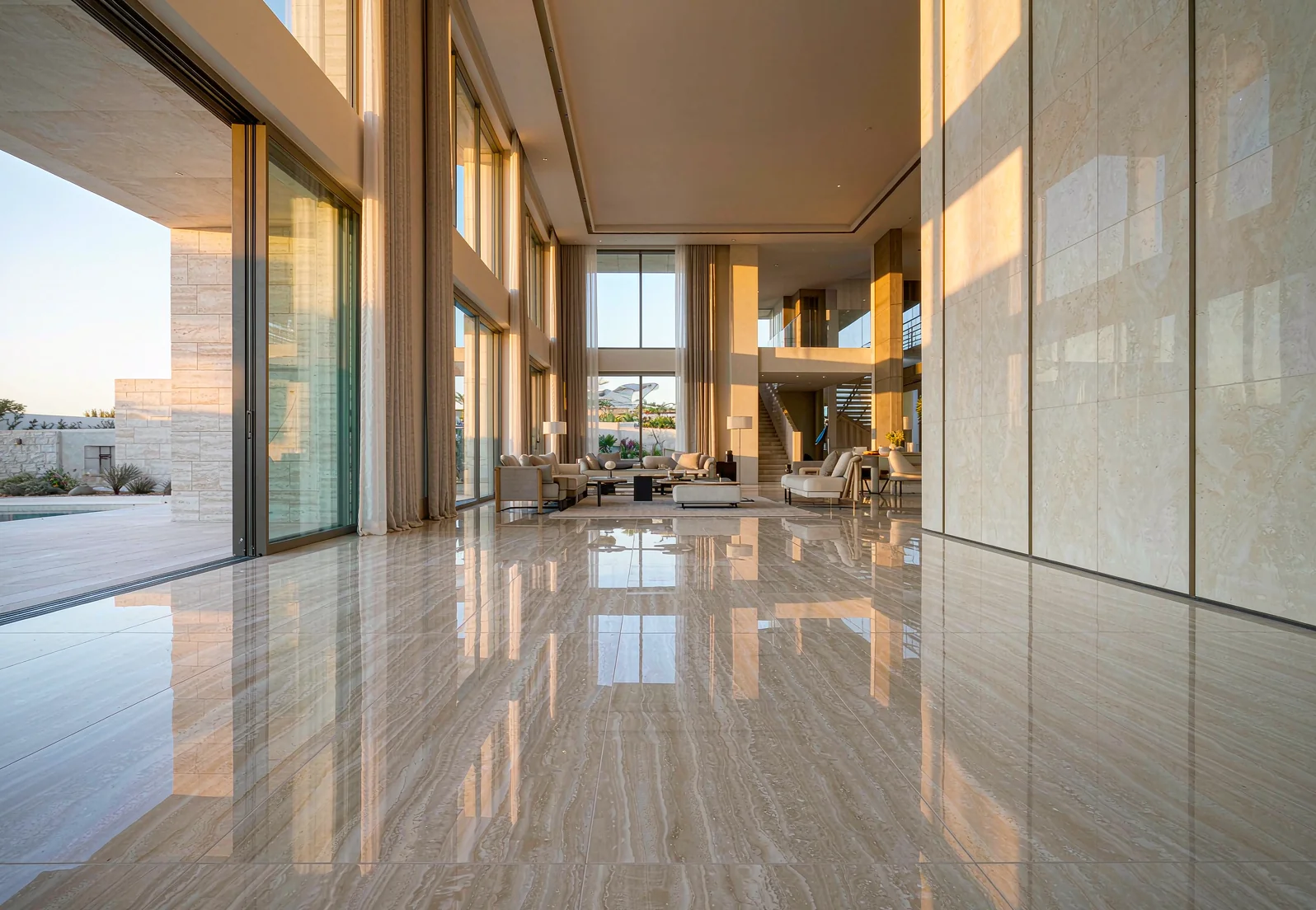
Across the Gulf, East Africa and the wider equatorial belt, tile is the workhorse finish — floors, walls, wet rooms, kitchens and terraces. It resists heat, scrubs clean and does not care about dust. But “tile” covers everything from a 300×300 mm glazed ceramic wall tile to a 1200×1200 mm through-body porcelain slab, and the wrong one fails fast under heavy traffic, direct sun and wind-blown sand. In our From Concept to Completion process the tile build-up is fixed early, because floor level, wall setting-out and door thresholds all key off it. Here is the decision framework we use with our own project clients, written for owners and project managers who need to read a tile schedule without a tiling contractor beside them.
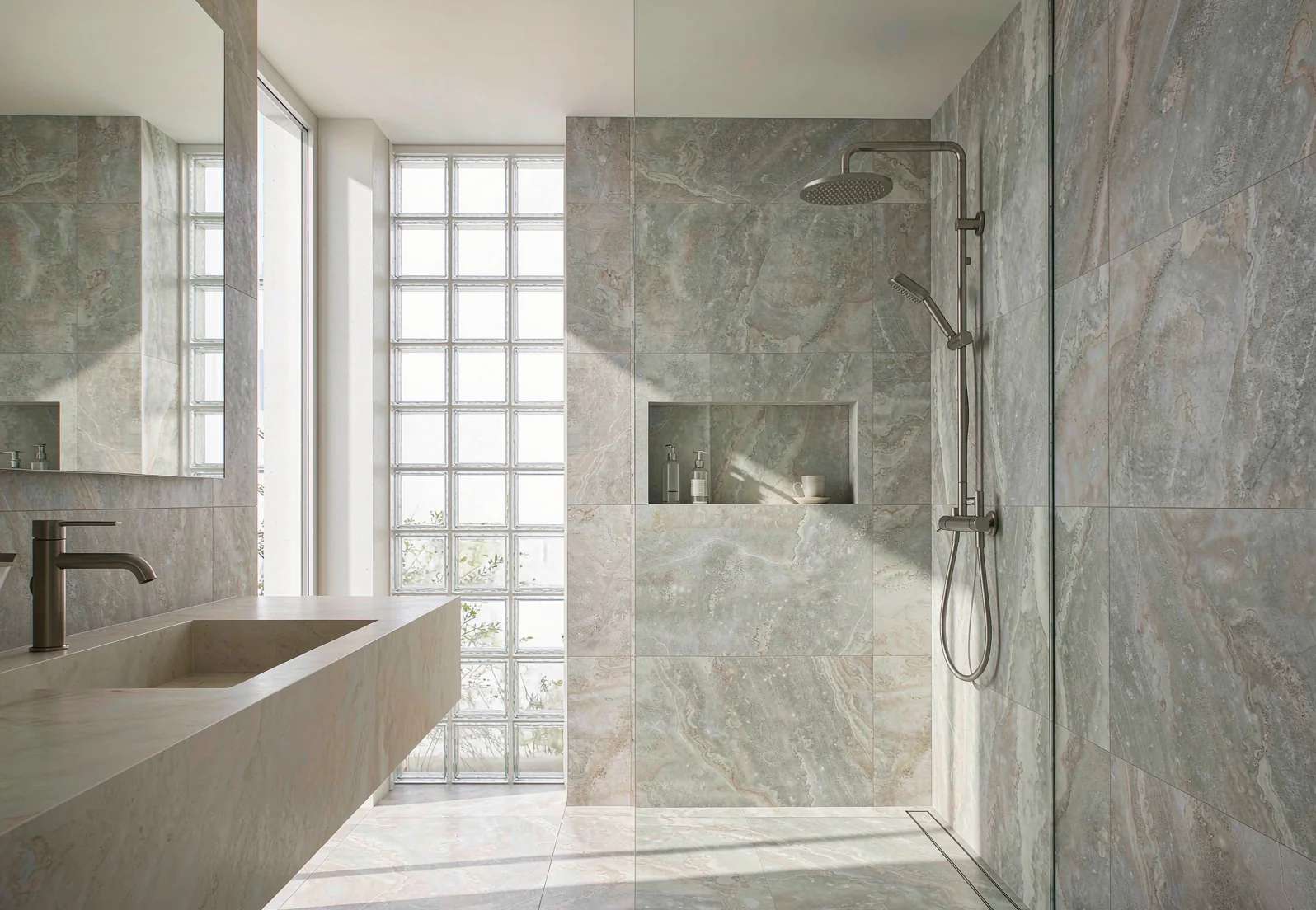
The single most useful number on a tile spec is water absorption, and it decides the body. Ceramic tiles absorb up to 10% moisture, which makes them light and cheap but dimensionally restless — fine for dry interior walls, poor for floors that see heat and traffic. Porcelain is pressed denser and fired hotter, so absorption drops below 0.5%: the tile is stronger, more stable and far less likely to chip or craze. For hot, dusty climates we specify full-body or glazed porcelain with a rectified edge for every floor and wet wall, and reserve ceramic for decorative interior wall features only. On commercial floors we also pin the abrasion class — PEI IV for hotel and office floors, PEI V for lobbies and retail — because a soft glaze polishes out into a dull track along the busiest walking line within a year. In our completed hotel and villa projects the tile schedule names the body, the absorption and the abrasion class together, never just a colour.
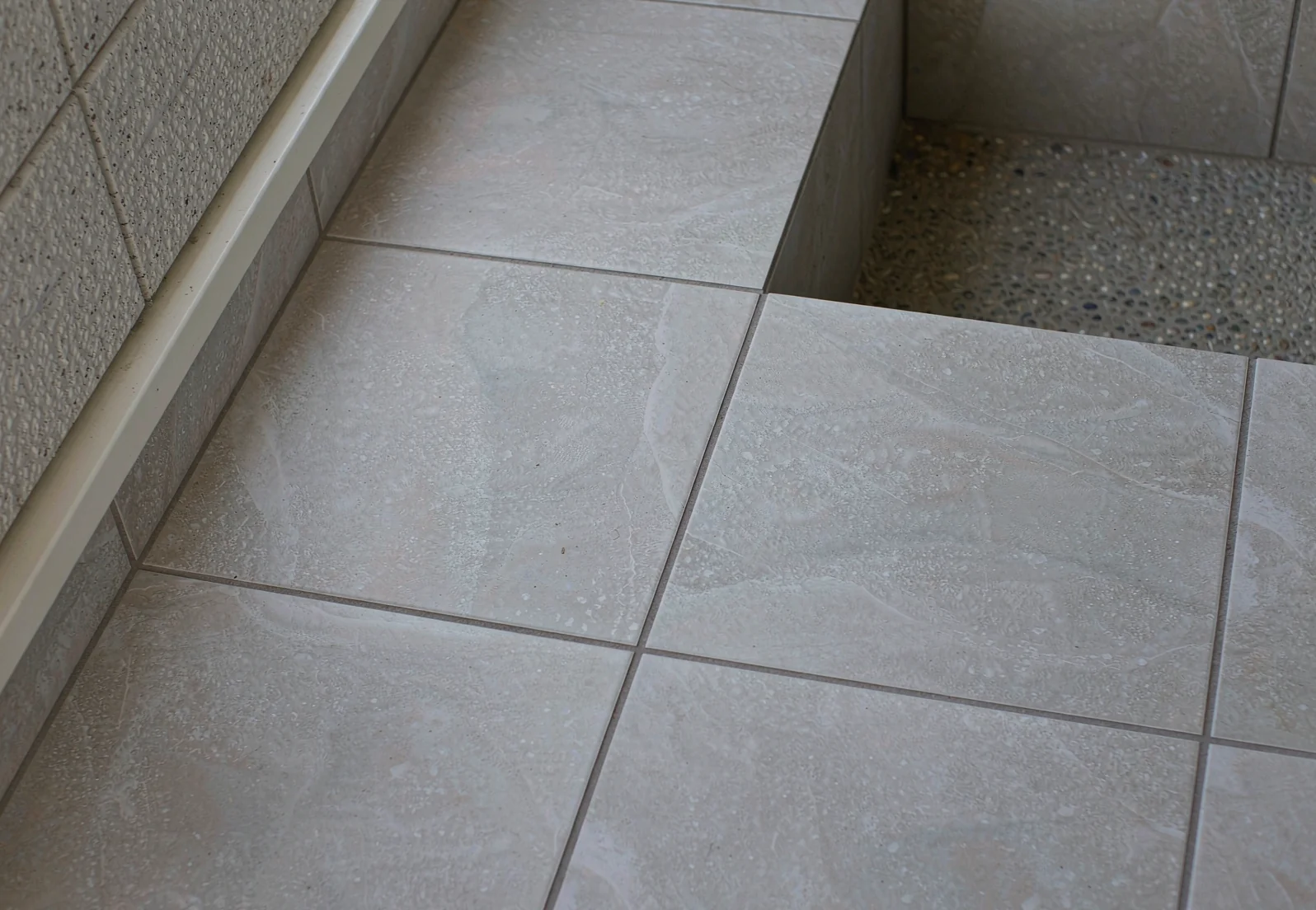
Dust is the enemy in the Gulf and the Sahel, and every grout line is somewhere dust collects. Moving up in format — 600×600, 800×800, 1200×600 and 1200×1200 mm — cuts the joint count for the same floor area and gives a flatter, more seamless surface that mops clean in one pass. It also changes the specification: large-format porcelain needs a flatter substrate and a full-bed adhesive, and it demands lash clips and a levelling system to hold the lippage within the 1 mm tolerance a big tile makes visible. We specify 9–11 mm thickness for interior floors and step up to 20 mm outdoor pavers where the tile is laid dry on pedestals or directly on sand-blinded bedding. For projects split by a door threshold, the whole build-up — tile, adhesive, screed — is set from one datum so the finished floor line is continuous across rooms. Rectified edges plus a 2–3 mm joint give the tight, monolithic look clients expect in a lobby; a wider 3–5 mm joint is more forgiving of minor size variation in economy tiles.
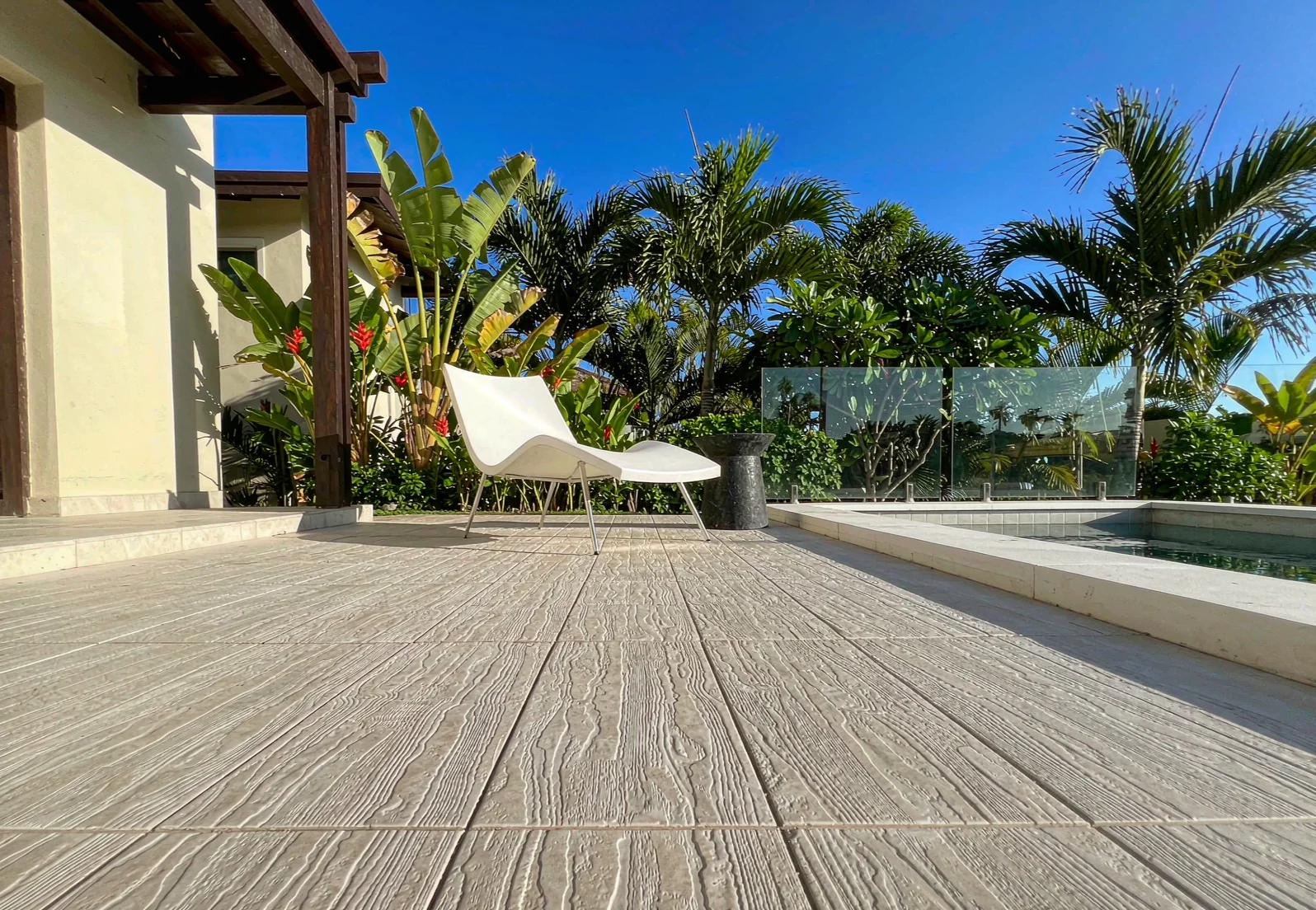
A polished tile is beautiful indoors and dangerous outside. In hot climates the risk is not ice but a sudden downpour, a pool splash or a wash-down with a hose — and a shiny tile turns into glass. We specify by slip rating, not by look: R9–R10 for dry interior floors, R11 for kitchens, laundries and covered terraces, and R11–R13 for pool decks, ramps and external steps. Where a project specifies by the American method instead, that maps to a wet dynamic coefficient of friction (DCOF) of at least 0.42. The finish does the work — a matt, structured or bush-hammered surface keeps grip even in full sun, and it hides the scuffs and dust that a gloss floor shows within days. For pool surrounds we also detail a slight fall away from the water and a drainage channel, because no slip rating saves a floor that holds standing water. Indoors we keep gloss only where it is dry and controlled, and even then we favour a semi-polished, lappato finish that reads as polished but keeps a measurable grip.
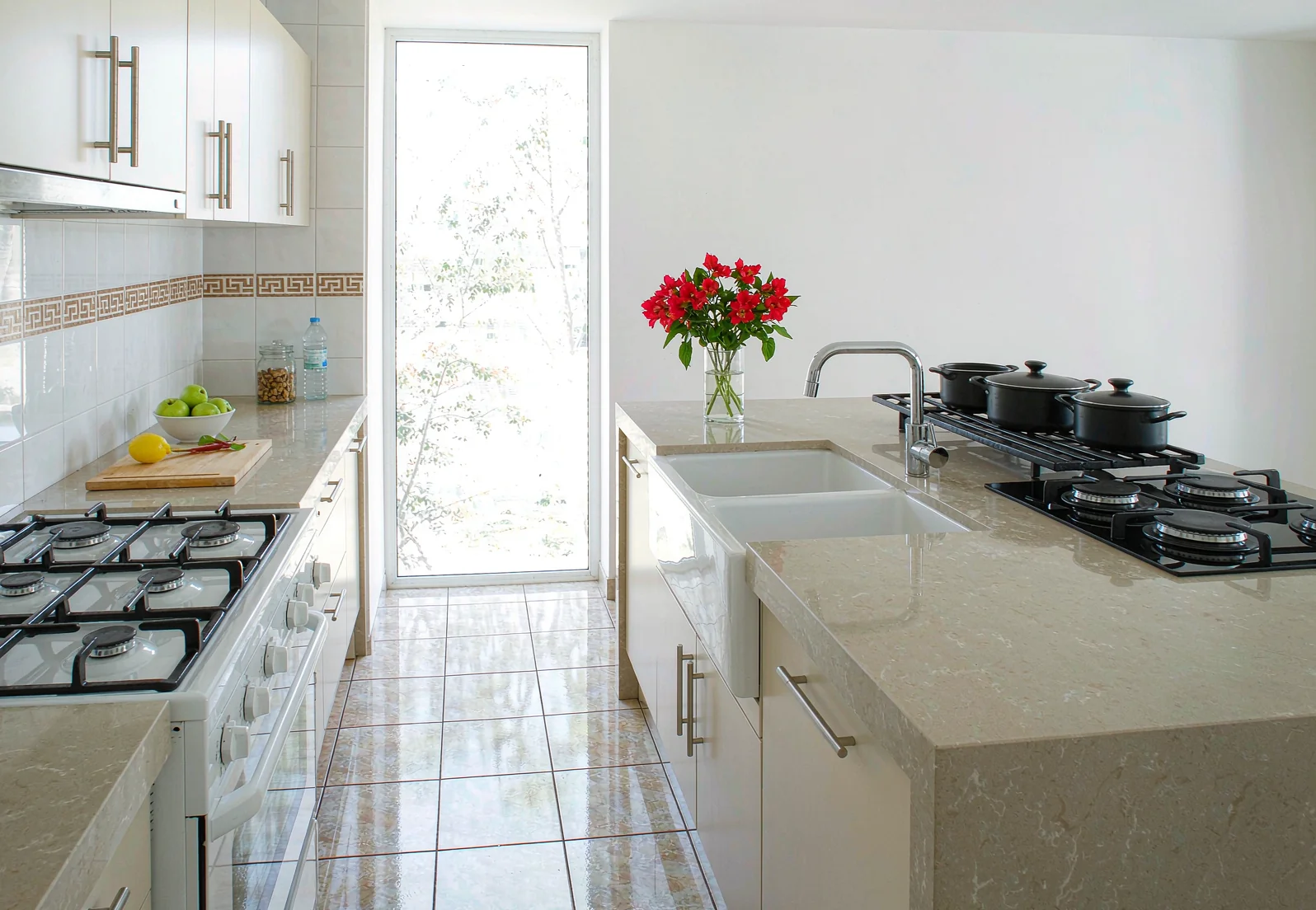
Tile fails at the layers under and between it, not in the tile. Three details decide whether a floor lasts a decade or debonds in one hot season. First, flatness: we hold the screed to within 3 mm over 2 m, because large-format porcelain cannot bridge a hollow and will crack over one. Second, the adhesive: a cement-based S1 or S2 class, full-bed and back-buttered, never the dot-and-dab that leaves voids for air and moisture to work under the tile. Third, movement: in a climate that swings between a scorching afternoon and a cool night, a rigid floor needs somewhere to move, so we set perimeter joints at every abutment, internal movement joints every 6–8 m and a flexible sealant rather than a hard grout at those lines. For grout we specify a fine, stain-resistant cementitious or epoxy grout — epoxy in kitchens, bathrooms and any food-service floor — because ordinary grout in a dusty environment absorbs dirt and discolours. The whole sequence, from substrate to curing, is written into the installation and junction detailing walkthrough we hand to every site team.
| Element | What we specify | Why it matters | Minimum spec for hot climates |
|---|---|---|---|
| Body | Porcelain, absorption <0.5% | Stable under heat and traffic | Rectified; ceramic for dry walls only |
| Format | Large format, 600×600 mm and up | Fewer joints, less trapped dust | 9–11 mm indoor, 20 mm outdoor pavers |
| Slip | R rating / DCOF matched to area | Stops falls when wet | R11–R13 pools and ramps; DCOF ≥0.42 |
| Adhesive | Cement-based S1 / S2, full-bed | Prevents hollows and debonding | Buttered back; no dot-and-dab |
| Joints | Fine cementitious or epoxy grout | Resists staining and dirt | Movement joints every 6–8 m; flexible sealant |
Share your drawings or area schedule and we will return an itemized tile BOQ with body, format, slip rating, adhesive and grout — typically within one working day.
Request a Tile BOQ →Use porcelain for floors. Its water absorption is under 0.5%, so it is denser and far more dimensionally stable under heat and heavy traffic; ceramic is fine for dry interior walls only. For how tile choices sit alongside other hard and soft floor finishes in the same climate, see our guide on Choosing the Right Flooring for Tropical Climates.
Large-format porcelain, 600×600 mm and up, at 9–11 mm for floors and 20 mm for outdoor pavers. Fewer grout lines mean less trapped dust and faster cleaning. When the tile meets joinery — islands, vanities, wardrobes — the levels and edges are set with the cabinet line, as we cover in Kitchen & Cabinetry Materials Compared.
Structured or matt porcelain rated R11 to R13, or a DCOF of at least 0.42 when wet. Polished tiles belong indoors only; outdoors they become a slip hazard in the rain. The falls, drains and junctions that keep a wet deck safe are detailed in Installing Cabinetry, Wardrobes & Metal Screens.
At the substrate, the adhesive and the movement joints, not the tile itself. Flatness within 3 mm in 2 m, a cement-based S1 or S2 adhesive and joints every 6–8 m are what stop debonding and cracking. For how the same material systems are specified market by market, read Specifying Interior Materials Across Five Markets, and for the adjacent openings and finishes see Specifying Aluminum Windows & Doors for Hot Climates, Specifying Durable Furniture Materials for Hot-Climate Interiors and What 200+ East African Project Enquiries Reveal About Material Specification.